
One Flight Up - Dexter Gordon

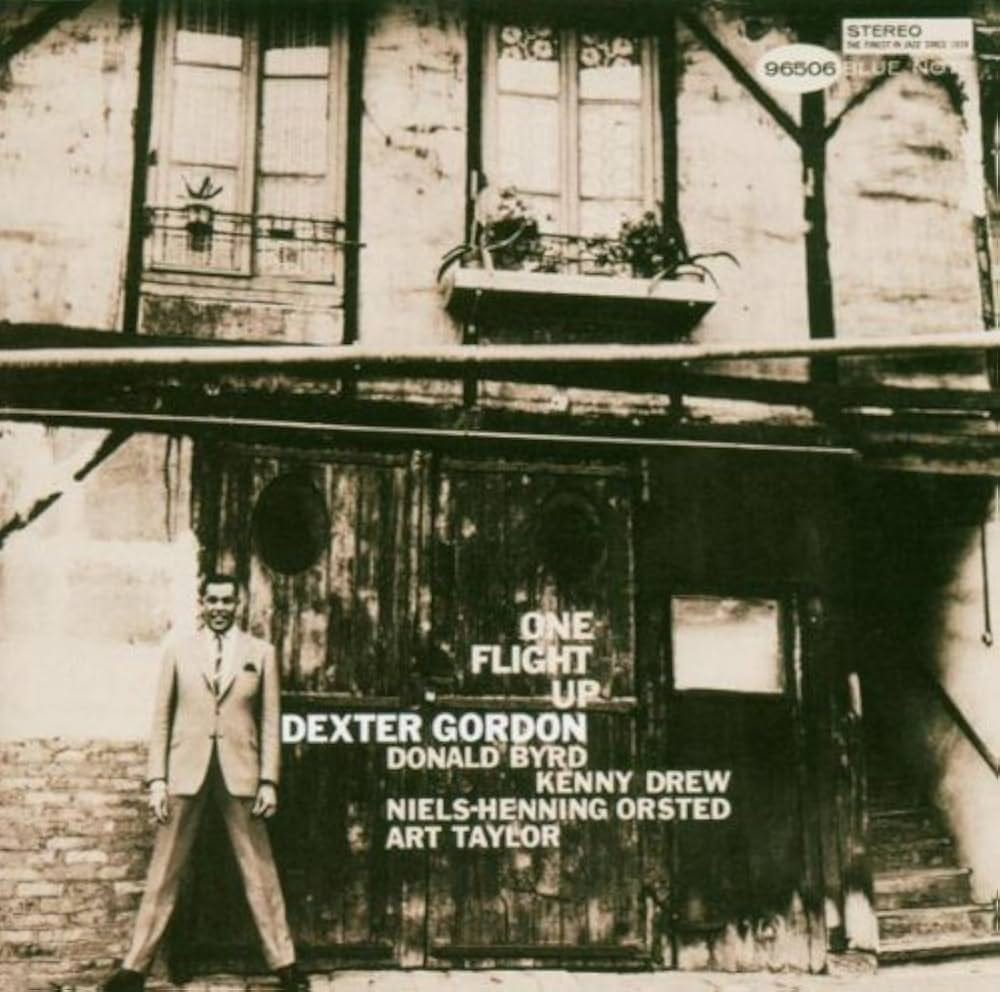
One Flight Up is an album by Dexter Gordon released by Blue Note Records in 1965 (BLP 4176) and recorded at Barclay Studios in Paris on June 2, 1964. The sound engineer is Jacques Lubin, production by Francis Wolff. The lineup includes Dexter Gordon on tenor saxophone, Donald Byrd on trumpet, Kenny Drew on piano, Niels-Henning Ørsted Pedersen on bass, and Art Taylor on drums.
In 1964, Dexter Gordon had been living in Copenhagen for two years. He had moved to Europe in search of the freedom that the United States denied him. As he himself said: “I felt that I could breathe, and just be more or less a human being, without being white or black.”
The opening track is “Tanya,” an 18-minute piece that occupies the entire A-side of the vinyl. A Donald Byrd composition that takes all the time in the world. You never get tired of listening to it.
On the B-side there’s “Coppin’ The Haven,” a Kenny Drew composition. The way Art Taylor plays here is something unique. Impossible to replicate.
And then there’s “Darn That Dream.” There’s a phrase at minute 3:17 of this recording. It lasts two seconds, maybe less. I couldn’t even describe it musically. But every time I hear it, my breath stops.
I was a kid when I discovered this record. I was studying drums and dreaming of becoming a jazz musician. It didn’t turn out that way, life decided otherwise. But that phrase at 3:17 is still there, every time I put this record on.
One Flight Up is one of those albums that demonstrates why European jazz in the ‘60s had a different sound. Freer. Less bound by commercial pressures and radio formats.
This is a great Dexter Gordon album. Thanks for your post! However, of the records in his Blue Note catalog, this one is my least favorite because of the recording quality. On the first two tracks the saxophone sits almost entirely in the left channel, and on Darn That Dream it remains mostly center right. He also sounds more distant from the microphone compared to the Van Gelder studio sessions, and the reverb is distracting. It has a high‑pitched ringing quality that is far too much for my preference. The other album recorded for Blue Note at this studio, Our Man In Paris was mixed by Claude Ermelin, and his use of reverb seemed somewhat more restrained.
Thanks for your post! I’m listening now to this record. Dig the tunes very much. Maybe I’ll get my quartet to play it at a gig someday. I would love to know the location of this photo & the significance of Dexter having his photo done there — assuming in Paris since that’s where the recording was done.